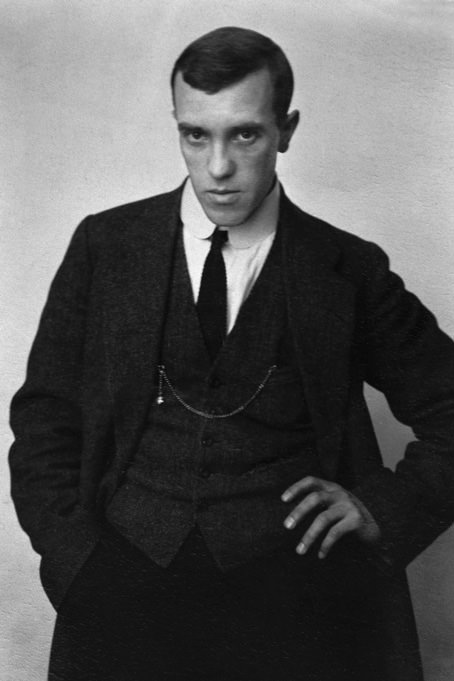

Pilvi Kalhama
In the heart of Estonia, amidst the serene landscapes of the early 20th century, there lived an artist whose work would challenge the status quo and redefine the boundaries of artistic expression. Konrad Mägi, a name not traditionally familiar to European art history, emerges today as a symbol of dissenting thinking and an embodiment of the avant-garde spirit. Mägi’s artistic journey was a relentless exploration of painting, of self, and of the world, driven by a deep-seated restlessness.
My aim is to understand Mägi’s uniqueness as a painter in the modernist era. It cannot be stressed enough that modernism as it evolved in the centres of European art is today much more than just a term for some formal qualities of style. In the case of Mägi, we need to consider the true diversity of modernism: its local variations.
In this paper, I will study three main areas while attempting to analyze the art of Mägi as a rupture of canonized modernism. These three aspects are:
1. Travelling as the feature of restlessness
2. The question of avant-garde philosophy at that time
3. Stylistic eclecticism as Mägi’s legacy
-> Conclusion: Mägi as avantgarde Maverick
Chapter 1: The Restless Wanderer
Konrad Mägi grew up in a time when Estonia was still under the influence of the Russian Empire. The young artist found himself caught in a cultural crossfire. The profound sense of not belonging to a particular place would become a central theme in his work, fuelling his philosophical contemplations on identity and the purpose of life.
Mägi’s restless moves from one place to another and his state of mind was expressed in the letters he sent. The letter tell how he felt alienated in many places. In his letters, we can study how he analyzes the places where he stayed as at the same time he as often expresses his will to be placed somewhere else.
“Paris is a horrible city where you can find anything. Finland is a paradise compared to Paris,”[i]
Search for belonging turned out to be not belonging in any place.
Mägi was not the only artist of the time to feel alienated. The history of art reveals many artists in the Northern countries and elsewhere who felt excluded and alienated at a time when for example existential uncertainty was the main ethos in modern literature. The undertow of conflicting emotions and harsh circumstances is reflected in the work of the generation of artists who swore by their own feelings. For instance, images of alienation abound in Finnish artist Ragnar Ekelund’s paintings of empty, wistful cityscapes.[ii] In some distant way this Ekelund’s art particularly reminds me of Mägi’s work. Mägi’s alienation in the face of the world’s metropolises is reflected by the fact that he hardly depicted any of the pace of the cities and streets, although the city life was a fashionable subject at the time. The greater inspiration for Mägi was nature. As Mägi himself put it, he wanted to fantasise in the silence and solitude of northern nature.[iii] Indeed, there is no modern architecture or technology in Mägi’s works. Human figures are almost totally absent, whereas the works can include a winding dirt road, a lighthouse, a hydroelectric power station or a barn – iconic signs of the rural milieu.
An admiration for the vibrant and noisy city could have emerged in Mägi’s paintings of Naples, Capri and Venice, but instead he gravitated towards a static silence, even in his urban views. In his paintings of Venice, the crowds and the center of the city remain somewhere on the distant horizon. And same appears in the Capri works.
However, I find the travelling itself as an enormous effect on Mägi’s art – not only literally but rather emotionally and philosophically. For example, the two periods he spent in Paris were significant, even if he was unable to channel his thoughts onto the canvas immediately: Mägi’s understanding of avantgarde art expanded in Paris. For example, we need to remember the fact that he first lived in a colony of two hundred artists and hardly saw anyone else maybe. A newly opened salon in Paris, which he saw, had 3,000 paintings on show simultaneously in year 1907![iv] Having spent an almost pictureless childhood and youth in Estonia, he was suddenly surrounded by world art. That must have been an experience coming very close to one’s identity. It would be narrow-minded for us today to not to understand that of course it wasn’t possible to transform that all directly into the canvas.
At the same time, we have to note, that Mägi was no exception in that he travelled so much; it was a typical thing to do of the times. The modern world was calling for an ideal of rapid transition, and travelling boosted the sense of disconnectedness. This thematics is for example discussed by Marc Augé in his writings about the anthropology of travel and placelessness.[v] This is exactly what Mägi’s art reflects – the shifting landscapes and changing styles in his works. His works are sort of snapshots of places seen by the modern individual, executed in a free and non-linear style. To sum up, Mägi’s whole body of work represents the modern state of mind: travelling as a target state of being.
Chapter 2: The Avant-Garde Ideas and the Quest for the Identity
Mägi’s journey led him to the of avant-garde art movement in Europe, where he encountered the radical thinking of the time. His exposure to modernist ideas in Paris and elsewhere made him to break free from the canons. Let’s study a bit in what sense.
As Finnish art historian, professor Altti Kuusamo points out, the system of French art academy was not only an important institutional player in the art scene of the day, it also led to the emergence of an innovative resistance on the outside.[vi] Non legitimized and informal art schooling which the academy system created is a key point when talking about Mägi. The prestigious cosmopolitan hub of art was thus the outcome of a movement that was both self-correcting and self-critical. Self-taught, non-bourgeois artists arriving in the metropolis in search of a vibrant artistic scene made Paris, in fact, exactly what it was: an international, intellectually, diverse and fascinating community of influences. For an artist just arrived from the periphery, as Mägi, Paris must have been a fascinating source of endless encounters and immense stylistic possibility.
In this atmosphere, Mägi used pigments to capture impressions of nature on canvas, but he used them in imaginative ways. He followed the path of Matisse, who stopped painting things in authentic, realistic colours. Matisse wrote in 1908: “To paint an autumn landscape, I will not try to remember what colours suit this season.”[vii] Mägi’s paintings convey a similar sense of the modern artist’s freedom to use colours and moods to disengage from the depiction of actual nature. And turning, instead, towards the vitality of nature in painting.
So, we can see that Mägi adopted elements and thinking from the avantgarde. But, at the same time, he was a disruptor of norms, and wouldn’t adopt modernist avant-gardism as a linear or stylistic norm like some others. He adopted the avantgarde as an ideology in its purest form I would say: by believing in challenging conventions and pushing boundaries of avantgarde itself. So, paradoxically, as he was growing to be an avantgarde artist, he became a critical viewer of the avant-garde, while many other artists of that time saw their position as artists breaking boundaries with realistic expression. Realism wasn’t the war Mägi was fighting against. He was entering into avantgarde as seeker of painting, as seeker of himself as an artist.
The rebellious Mägi, as we know him, is easy to place into the image of a bohemian revolutionary vanguard. Therefore, he was an invention of the modern era instead of being an exception. He was looking for entry into the avantgarde from the perspective where he would be able to make choices of his own free will – not of the mainstream of the avantgarde. However, his lifestyle, like travelling, being poor, expressing himself suffering, associate a very common lifestyle of the time – especially the lifestyle of an artist.
So to sum, as Mägi traversed the European art scene, he was not merely searching for artistic inspiration; he was, rather, searching for the lifestyle which would then affect him as a painter. In the midst of his artistic exploration, Mägi grappled with questions of purpose and disobedience.
How is that seen on canvas, then? According to Kuusamo, emphasising colour as a kind of antithesis to the line was, in those days, linked with the possibility of adopting the identity of a bohemian artist.[viii] The idea that colour could have been more than “mere” matter on canvas is actually quite intriguing. If colour was a medium for expressing otherness, it also embodied a link to the politics of the subject. It is fascinating to think that Konrad Mägi may have adopted such an idea; that he could have chosen colour painting as a means of constructing his identity as an artist. And it really makes sense, since the formal styles were so dominant aspect among artists in centers of European art. Colour offered a field more free.
We can also pay attention to the fact that the colours painters use, are pigments. Meaning, pigments originating in nature, are material which links a painting to the living world and the nature.[ix] As David Batchelor writes in his book Chromophobia about colours and fears associated with them, Western culture has been quite active throughout the 20th century in denying colour from culture, denying its significance and complexity.[x] As a consequence, colour has become deliberating opposite to rational Western order. Colour is something strange, something that tells us of the existence of instincts, of things that cannot be controlled.
It is possible that taking colour as the starting point of painting was a message – Mägi’s very own visual manifesto. In the years of his active engagement with painting, Mägi made colour an increasingly important part of his brand of modernism. Mägi knew, either consciously or from intuition, how to use this cultural trope, which in the early 1900s was known as bohemianism. Perhaps it was his way of battling canons. Within this thinking colours represent a sense of otherness and non-belonging in the mainstream, as it in Mägi’s case was something very exceptional from most of his colleagues.
Mägi seems to have been fairly critical eye on other artists throughout his career and he did not shy away from questioning even those of his colleagues who enjoyed popularity. In Finnish Akseli Gallen-Kallela’s case, for example, Mägi thought his status overrated although he did express his view in appreciative terms. Nevertheless, Mägi’s critical stance is probably one reason he tended not to idealise stylistic choices or external qualities. Instead, he searched for the purpose of the artistic expression, considering what he saw in terms of his own development. This is a frequent theme in Mägi’s thinking and he therefore reserved his hardest criticism for himself. He was a true self-critical avant-gardist.
To sum up, Mägi must be looked at inside modernism and not outside of it. Mägi assimilated modernist styles with ease, and European movements do not seem to have been either irrelevant or self-evident for him in any way. In his biography, Epner describes Mägi’s desire to define himself not only as an artist, but also as an innovative artist.[xi] His criticism of Gallen-Kallela mentioned earlier also highlights Mägi’s ideas of art from precisely this perspective: “I still consider Gallen a great artist, although I used to hold him in higher esteem than I do now. Gallen has not added anything new to art,”[xii] Mägi writes. He was obviously preoccupied by the progressive nature of modernism and the development avantgarde.
In this sense he was a product of his time, an advocate and a representative of modernism. All artists across Europe were busy developing abstract idioms of their own. The term modern itself, meant “updated” or “improved”.[xiii] The rapid development of styles gave rise to a kind of art race that we have come to call European modernism and the period is generally dated to the period between 1880–1940, regardless of artist, country or source. Mägi’s career falls easily in the heart of the modernist period. He entered its sphere directly, without need to shake off any previous periods of art. There is nothing to suggest that Mägi’s conception of modernism would have involved indifference or lack of understanding.
Chapter 3: Stylistic Eclecticism as Mägi’s Legacy
Mägi’s response to the avantgarde time was a fearless, stylistic liberalism.
His stylistic eclecticism, a fusion of Impressionism, Expressionism, and Symbolism, just to name few, challenged the rigid boundaries of art. His restless spirit manifested in every brushstroke, every stroke a testament to his defiance of the ordinary. In this occasion I have not time to take a look on Mägi’s stylistic freedom but I have gone through his body of work from the stylistic perspective more in detail in my essay “Sense of Style”in Konrad Mägi. The Enigma of Painting (2021)
I am only summing up some visual remarks:
- Mägi’s dots create a spirited impression (for ex. Post French period works). He distances himself from the demand for realist depiction, which the impressionists continued to hold on to. The works break away from real-world impressions of light, and the colours become pale, light and limpid.
- The works become increasingly self-contained, autonomous, painterly impressions – snapshots and moments in a semi-imaginary landscape (like in the famous Sea Kale work).
Even though we want to know which exact places Mägi painted, it’s not about the specific place, it’s a about impression of climate, or of colour, or of sunlight, it’s about impression of geology or flora, and these kind of things. For the viewer, this deliberate choice of style is secondary. The overriding impact is the atmosphere.
- In portraits, on the contrary, Mägi demonstrated a mastery of a variety of styles. He focused on strong colours and compositions that put the subject and the background on equal footing in the picture plane in a fauvistic way: Mägi’s approach to portraiture reveals his primary aim: to create art, a likeness of the subject being a secondary consideration. Roma Girl
The stylistic diversity in Mägi’s work in many ways violated the philosophy of his day of “pure” modernism.
By switching styles, Mägi shifts intensity and mood on the canvas, and having the disturbance and dislocation the key features of his work.
Saaremaa Landscape is a nice example of Mägi’s eclectisism: stretched sky is rendered in an unorthodox pointillist manner, and the fields in the bottom part are painted with thick, stylised and distinct brushstrokes. I call this painting a shameless one.
From a contemporary perspective, Mägi’s solutions are intriguing, particularly in view of the fact that eclecticism as a concept only appeared in art in the 1980s with the advent of postmodernism. The term denotes a philosophy that allows styles to be combined at will. In postmodern art, eclecticism was an ironic way of mocking the modernist demand for stylistic purity in the past. The idea was to free art from the demands of constant stylistic evolution.[xiv] In his time, Mägi was an exception who points the way to a contemporary language of art that has only recently found a place in written art history. He was an unwitting early postmodernist. Or, in modernist terms: a true avantgardist, a front-runner, a trailblazer of local modernism.
Conclusion:
Mägi was unafraid to experiment. Mägi’s art speaks to those who have ever felt the feeling of not belonging, the urgency of dissenting thinking, and the profound search for identity and purpose. Mägi’s restlessness and reluctance to settle down for any length of time is seen today in the fusion of different impulses in his work.
His life and work reminds us about original avant-gardism – not about the avantgarde which itself became as a stylistic canon.
Thus, we should call him an Avant-garde Maverick. Combining the two terms, “avant-garde maverick” refers to an artist or person who operates in an open-minded and experimental way in the field of art, while at the same being independent and self-willed, often deviating from prevailing art trends and traditions. Such a person may be known for their bold and radical art that challenges artistic conventions and norms. It may well be, that especially because of coming from a periferic country, it naturally gave him this attitude and more possibilities to obey his personal views and feelings, not necessary to obey the centers – which in the end paradoxically meant the building of canons.
Personally I have started to look at Mägi’s body of work as contemporary art. This viewpoint of course may raise more new questions than give answers, like for example a question of when and where does contemporary art begin. However, for me, contemporary art is an attitude and while I understand a certain radicalism or self-critical view as key feature of contemporary – of course originating from the avantgarde ideology – I find Mägi very similar to contemporary artists’ attitude. Still admitting that in many ways he was a typical production of his time, as I have argued above.
Thus, we have contemporary art and the study to thank for the current situation in which we are able to reinterpret modern art in its all diversities – with new eyes. Instead of continuing the categorising of art, we are coming to the situation which might be called an expanded field of avantgardism.My formulation borrows, of course, from art theorist Rosalind Krauss’s famous article “Sculpture in the Expanded Field” from 1979 in which she rejects the categorical approach to art in which each medium is governed by formal rules. Krauss wrote her essay by challenging the traditional, normative, prescriptive and classificatory concepts or simplistic analysis.[xv] Krauss’s thinking helps us see art as a stage for multiple and diverse interests and interpretations, as what Konrad magi represents.
[i] Mägi, letter dated on 16.12.1907, Epner 2018, 148–149.
[ii] Ahtola-Moorhouse 2001, 121. ”Mielen maisema”. In Pinta ja syvyys. Varhainen modernismi Suomessa 1890–1920. Ed. Riitta Ojanperä. Helsinki, Ateneum Art Museum / Finnish National Gallery. Ateneum Art Museum publications no. 24; on Ekelund, see exhibition brochure Pinta ja syvyys. Varhainen modernismi Suomessa 1890–1920. Ateneum 8.3.–30.9.2001: in Esikaupungin katu (1915), Bäcksbacka Collection.
[iii] Mägi, letter dated on 25.4.1908, Epner 2018, 155.
[iv] Mägi, undated letter from 1907, Epner 2018, 147.
[v] See Augé, Marc 2006, 86–87. Non-Places: An Introduction to an Anthropology of Supermodernity. New York, London, Verso; see also, e.g., Birkeland, Inger 2005, 63. Making Place, Making Self: Travel, Subjectivity and Sexual Difference. Cornwall, Ashgate; University of Bergen.
[vi] Cf. Kuusamo, Altti 1998, 14–27. “Akatemian idea ja taiteiden järjestelmä”. In Silmän oppivuodet. Ajatuksia taiteesta ja taiteen opettamisesta. Kuvataideakatemia 1858–1998. Ed. Riikka Stewen. Helsinki, Finnish Academy of Fine Arts.
[vii] Matisse, Henri 1996 (1908), 75. “Notes of a Painter”. In Art in Theory 1900–1990. An Anthology of Changing Ideas. Ed. Charles Harrison & Paul Wood. Cambridge, Massachusetts, Blackwell.
[viii] Kuusamo, Altti 1998, 25. “Akatemian idea ja taiteiden järjestelmä”. In Silmän oppivuodet. Ajatuksia taiteesta ja taiteen opettamisesta. Kuvataideakatemia 1848–1998. Ed. Riikka Stewen. Helsinki, Kuvataideakatemia.
[ix] Graw 2018, 23.
[x] Batchelor, David 2000, 22–23. Chromophobia. London, Reaktion Books.
[xi] Epner 2017, 347.
[xii] Mägi, undated letter from Paris, Epner 2018, 150.
[xiii] Williams, Raymond 1992, 23. “When Was Modernism?”. In Art in Modern Culture: An Anthology of Critical Texts. Ed. Francis Frascina & Jonathan Harris. London, Phaidon Press.
[xiv] Eclecticism is a frequently discussed subject in architecture in particular but also in the visual arts. There is a wealth of social and art theoretical literature on the subject: e.g., Huyssen, Andreas 1984, “Mapping the Postmodern,” New German Critic No 33. Duke University Press; Foster, Hal 1989 (1983), ”Mullistavia merkkejä”. Modernin ulottuvuuksia. Fragmentteja modernista ja postmodernista. Ed. Jaakko Lintinen. Jyväskylä, Kustannusosakeyhtiö Taide.
[xv] See Krauss, Rosalind 1989. ”Sculpture in the Expanded Field”. In October, Vol. 8. (Spring, 1979).