
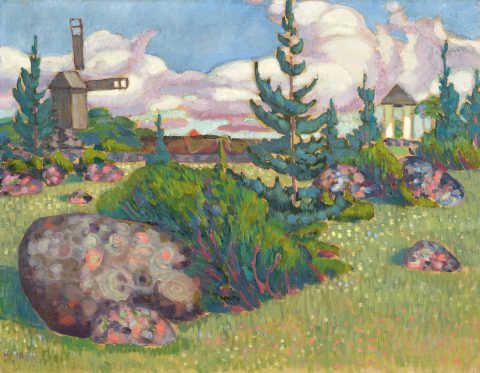
Kihelkonna, the island of Saaremaa, Estonia. 1913–1914
Konrad Mägi spent time in Kihelkonna during the summers of 1913 and 1914. There were wooden sheds on the coast of Abaja Bay in the vicinity of Kihelkonna, where medicinal mud baths were offered to treat polyarthritis.
In Kihelkonna, Mägi painted the local church and the adjacent bell tower on several occasions. It is the only preserved bell tower in Estonia today that is separated from the church.
Mägi’s fascination with the area around Kihelkonna and Vilsandi Island in particlar ushered in a new period in his creative career. On the basis of formal characteristics, it comes across as a life-affirming and optimistic period: paintings are full of colour and light, compositions are well balanced, space is rendered harmoniously, and the literary plots of works are observing of the world, not interfering with its course. Mägi’s scarce reports from Saaremaa are also more joyous than his letters from Tartu or Viljandi, sent only a short while back, exuding a darkness generated by depression.

Kihelkonna
- Landscape with a Church Art Museum of Estonia

- Kihelkonna Church and the bell tower

- Kihelkonna Church

- Kihelkonna Church



Konrad Mägi painting locations
- Åland, ÖnningebyFinland1906
- EidskogNorway1908–1910
- NormandyFrance1911
- Vilsandi IslandEstonia1913–1914
- Kihelkonna, the island of SaaremaaEstonia1913–1914
- Abaja Bay, the island of SaaremaaEstonia1913–1914
- Kudjape Cemetery, the island of SaaremaaEstonia1913–1914
- ViljandiEstonia1915–1917
- Lake Verijärv (Lake Kasaritsa) and its surroundingsEstonia1916–1917
- Lake PühajärvEstonia1918–1920
- OtepääEstonia1918–1920
- Kuressaare, the island of SaaremaaEstonia1920
- NaplesItalyMarch and April 1922
- CapriItalyMarch and April 1922
- RomeItalyDecember 1921, April–June 1922
- VeniceItalyJune 1922
- OberstdorfGermany1922
- SaadjärveEstoniaSummers of 1923–1924