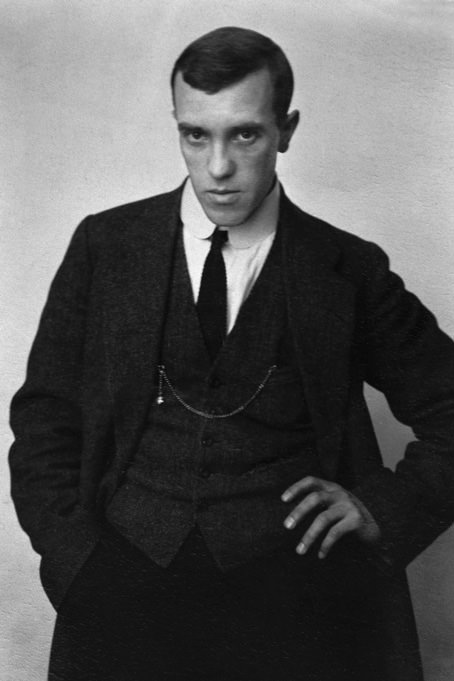

Timo Huusko
In a letter he sent from Paris to Anni Vesanto in Helsinki in 1907, Konrad Mägi wrote that he had been reminded of the words of a Polish poet:
“Oh, son of this poor land,
he who from the rustling fields
gathered together that strangely disturbing murmur
and took his songs and thoughts into the world”
And then he added rhetorically: “I mean, this is a real poet who gathers ‘murmurs’ from the fields. Good, isn’t it?”
At the time he wrote the letter, Mägi had only painted a few pictures in the Åland islands in the previous summer, yet the poet’s idea of “gathering disturbing murmurs from rustling fields” is an fine description of the fundamental ethos of his art. Allegorically, of course, the act of capturing those murmurs in art meant the expression of nature in painting. Mägi’s need to portray nature as he saw it through the lens of his own emotions was so strong that nature sometimes appeared almost divine to him. Mägi felt awed especially in the face of the majesty of northern nature, yet during his stay in the Åland islands, he reminded himself that the human spirit is great enough to create entire new worlds. After moving to Paris at the end of 1907, he added to this the notion that, for the soul of an artist, [quote] “there exists a nature of things that is free of objects and space, and is beyond time” [end of quote].
The importance of the connection between man and nature links Mägi to the romantic tradition, and also certain key elements of his pictorial space are derived from romanticism. One such element is the vantage point, which Mägi constructs in such a way that it pulls the viewer into the landscape and subjects her to the nature experience depicted on the canvas. Other things in Mägi that are typical of the period and its modernist aspirations include the idea of encapsulating a primitive life force in art, and the dualism between heroism and suffering in his artist persona. In Mägi’s thinking, the bridge that leads from romanticism to modernism was his conviction that one can find peace only in art.
In my talk, I will focus on Mägi’s emotionally expressive art and how his ideas and artistic identity can be read from his work. I will focus on three issues: the transference of emotional experience; the dualism between the Nietzschean man of will and the suffering artist; and the idea of northern art and its significance in Mägi’s work.
Roughly speaking, we can distinguish between two types of spatial composition in Mägi’s landscapes. One of them features a distinct illusion of depth and a vantage point where the painter and the spectator, too, can imagine herself contemplating the view. The other compositional type is more straightforward. In it, the viewer is placed in front of a stylized, pointedly two-dimensional landscape that is raised up vertically. This slide clearly shows that Mägi used these methods to varying degrees already in his Norwegian landscapes painted between 1908 and 1910.

It’s obvious that features of a landscape gave rise to intense emotions in Mägi, and that they also gave him a sense of familiarity. Having travelled from Åland and Helsinki to Paris in 1907, he wrote to Anni Vesanto, the daughter of his landlord in Finland:
“I am a son of the North and everything in me is nothing but a particle of the entire people and our nature. Wherever I happen to be, the North always remains my homeland (in the broader sense). I like the wistful, harsh nature of the North, the bright glimmers of sunlight that can often be seen in the work of local artists.”
With its focus on the connection between landscape and the human mind, Mägi’s vision can indeed be called national romantic. The idea of correspondence between nature and humanity, a unity of nature and the mind, was an aspiration in early German romanticism. This idea, championed by Friedrich Schiller, found its transcendental expression in the paintings of Caspar David Friedrich.

Of course, the idea of appropriating nature as a landscape and a mental conception, as an embodiment of one’s consciousness and a cornerstone of identity, was of much earlier provenance, its roots going back at least to the 17th century, as Svetlana Alpers has shown in her study of the cartographic features of Dutch landscape painting. German romanticism also played a part in Estonian nationalism in the late 1800s, although I do not know what Mägi thought about it. We can assume, however, that, in addition to Finnish art, Mägi was also familiar with the Nordic genre of the so-called “mood landscape” – “stämningslandskapet” in Swedish – which was founded on the idea of constant interaction between nature and the artist’s mind, and the expression of that influence in art.

There are almost never any people in Konrad Mägi’s landscapes. However, a few paintings feature an almost symbiotic union between the landscape and a human figure. I am thinking of Portrait of a Norwegian Girl (1909, Tartu Art Museum) and especially Meditation (Landscape and Woman), (1915–1916, Estonian Art Museum).

What’s particularly intriguing about the portrait of the Norwegian girl in her national costume is that, instead of a landscape, the background appears to be a wall rug that symbolises the national mindscape. Both these paintings connect the feminine element with the ground, its character and its vitality. That connection was a fairly common topos or image type in art of that period. These two works, however, are important in this context because they illustrate Mägi’s intense relationship with nature as well as the powerful connotations between landscape and the human mind. Mägi also painted at least one portrait of a man, which can be considered a symbolic landscape: Portrait of Pastor Johannes Ernst Mickwitz (1915, private collection)

With its distinctly symbolistic emphasis on the correspondence between nature and the soul, the windswept landscape seems to be an embodiment of the thoughts moving in the pensive pastor’s mind.
The varied shapes of the so-called ‘northern’ landscape – valleys and hills set against the sky, waters glittering below – are capable of producing what is known as ‘threshold situations’ in the viewer’s mind. On their travels, artists would in fact expose themselves deliberately to such encounters. These liminal experiences – “räumliche Schwellensituationen” to give the German term invented by Johannes Hauck – could be produced especially by cliffs, shorelines, mountain tops, riverbanks and areas bordering between nature and cultural space. Mägi was clearly drawn to such threshold features in the landscape, sketching the views rapturously and later painting them in his studio either impulsively or with deliberation. I’m afraid I do not know whether he painted landscapes also outdoors, but if someone knows, I would be glad to hear about it.
If we compare Mägi’s landscapes from Åland and Norway with the landscapes painted by another Estonian artist, Nikolai Triik, it is interesting to note that Triik tended to paint the sky whereas Mägi usually depicted tracts of land.

In Mägi’s paintings, the horizon is very rarely below the centre line, suggesting that the vantage point is located just above the ground, which opens up the terrain to view more widely. This is particularly notable in works containing diagonal lines that enhance the sense of depth.

What originally captured Mägi’s interest in a landscape, may touch the viewer of the finished painting even today. In some of Mägi’s landscapes, the pictorial space is composed in such a way that the point of view is occupied by an ‘internal spectator’, a term coined by philosopher Richard Wollheim. The internal spectator sees the view from the same perspective as the person standing in front of the painting, but within the illusory landscape of the depicted image. Some of Mägi’s landscapes are such that the viewer becomes aware of the artist himself as a traveller who experienced the landscape physically. The painting communicates some aspect of the experience to the viewer, who can imagine herself being in the actual place. This response tends to occur in works where the middle ground is absent, that is, where the pictorial space is clearly divided into a zone where the artist-traveller is located – often at a high scenic spot – and a zone in the distance, such as a line of hills set against the background of a cloudy sky, with an inaccessible natural feature – a hollow, river, lake or bay – intervening between the two. It is in such a configuration of features that the liminal threshold experience is engendered which can enrapture the artist and viewer alike.
This pictorial configuration is present in certain landscapes Mägi painted near Kihelkonna in Saaremaa and on the nearby island of Vilsandi in 1913 and 1914, as well as in some later works, such as the landscape views he painted at Pühajärv in 1918–1920, or the painting On the Road from Viljandi to Tartu (1914–1915, Estonian Art Museum). In some of the Saaremaa images, the horizontal landscape appears as if it were slightly tilted, to an imaginary angle of about 40–50 degrees, which directs attention to the foreground and raises the land closer to the viewer, allowing its colours and shapes to create a strong emotional response. One of the works where this illusion can be observed is Sea Kales (1913–1914, Estonian Art Museum).

The Saaremaa landscapes also illustrate Mägi’s new approach to colour, which must have been inspired by his trip to Paris in 1912, his stay at the Académie Vassilieff and his encounter with neo-impressionist art at the Salon des Independants. Mägi’s skill in creating luminous effects by using colour juxtapositions and blending different hues in discrete small surfaces side by side, gives his paintings a sensory power that seduces the viewer and pulls her into the painting, as noted by Pilvi Kalhama in her writings about Mägi.
It has also been argued that we have Mägi’s paintings to thank for the fact that Saaremaa has become a visual embodiment or metaphor for Estonia. However, Mägi’s virtuoso use of colour makes it possible to find rapport with his works, to discover in them a correspondence with one’s inner feelings, even for those who know nothing about Mägi or his life.
—
I want to say a few words about Mägi as a modernist, perhaps even as an avant-garde artist. The latter label has to do with Mägi’s transgressive treatment of the subject in some of his Norwegian landscapes. The most famous of them is probably Norwegian Landscape with a Pine Tree (1910, Art Museum of Estonia),

a work that seems almost to have been painted in a fit of delirium. Eero Epner has argued convincingly that the painting reflects the influence of Swedish writer Ola Hansson’s collection of short stories entitled Sensitiva amorosa (“Sensitive Lovely,” 1887), which made a profound impression on Mägi. Mägi wrote to Vesanto about the collection in early 1908, and describes Hansson by quoting the words of a critic:
“He draws the world as something uninterrupted. He doesn’t accentuate discrete points in that flood of phenomena, he doesn’t register them like people have done, describing them as “things”, “boundaries”, “contradictions” – for him this flood is not interrupted anywhere. There are no contrasts for the new spirit, no contradictions, since everything is presented to its reason – like an endless chain of transitions of feelings that is constantly changing, which quiver in all tones and colours but in their richness are inseparably tied to one another since there are no doubts that do not turn into cranial nerve oscillations and conscious vibration.”
Many of the features mentioned in the passage are quite prominent in the painting – the transcendence of time and place, the quivering of tones and colours, the nervous oscillation of abstracted forms – although one can tell that the work depicts a marshland in the light of the setting sun as seen from a hill. In Mägi’s vision, however, the view is transformed into a two-dimensional apocalyptic scene dotted with oval eye-like geological-volcanic shapes.
As an image of the internal world of emotions, the painting is reminiscent of Edvard Munch’s symbolic works, albeit with a higher degree of abstraction. Mägi had seen some of Munch’s paintings in Paris at the Salon des Independants in 1908, and already then he made the observation that “the most interesting of all of them is a Norwegian painter Edvard Munch.”
From the modernist perspective, the intriguing thing about Mägi’s art – in addition to his distinctive philosophy of colour and free treatment of motif – is his vitalist yet anguished dualism, and how it became part of the general artistic context of his time. Mägi had been an athlete and a keen fighter in his youth. Physical bragging and what we would call toxic masculinity were quite common in those days, especially among artists from an agrarian background. Examples abound, at least in Finland, the best known being Tyko Sallinen, Mägi’s contemporary with whom Mägi even studied for a short while in Helsinki.
It appears, however, that Mägi’s torn background and his bouts of illness made him see life as a torment from which only art could bring at least temporary relief. His rhetoric of suffering is also associated with Nietzschean pathos, possibly adopted from Nikolai Triik during his time in St Petersburg around 1903.

Yet it has been observed that Mägi would also complain about hunger and poverty even when there was no apparent reason to do so. Could this have been a facet of his persona as a bohemian artist?
Regarding the subject matter of Mägi’s art, an explicit depiction of suffering only surfaces in the lost Pietà painting from 1919.

We should note, however, that likening of the artist himself or the destiny of his nation to Christ was not an uncommon theme in contemporary art of the period.

Artists were drawn to Nietzsche’s idea of the Übermensch-artist who held disdain for the bourgeoisie – a supreme individual with the strength of will to rise above the status quo and carve a unique path he alone could travel. Without downplaying the challenging conditions Estonian artists faced at the time, coupled with their lack of institutional support, we can observe the emergence of the “suffering male artist” as a kind of trope later reinforced by art literature. In one of her articles, Tiina Abel has pointed out that this is how the archetype of the “freezing artist” became part of Estonian art history. A similar phenomenon unfolded in Finland, particularly among the artists associated with Tyko Sallinen’s circle, a trend described by Viljo Kojo in two novels from 1922 and ‘23. In European art literature, the starving yet totally committed bohemian artist is often associated with the streets of Montparnasse – names like Modigliani, Soutine, and Chagall come to mind. A notable landmark often included in accounts of the quarter was La Ruche, or the “beehive”, a legendary artist’s residence which was also frequented by Mägi and other Estonian artists.
Instead of examining Mägi’s bohemian persona as a role, perhaps it would be more to the point to see him as a representative of modern decadence in the sense that Mirjam Hinrikus has discussed the phenomenon. This might help explain the alternation between contrasting elements, such as primitive behaviour and neurasthenia, sophisticated attire and suffering, illness and a sense of strength, or restlessness and the accompanying frustration with provincialism and metropolitan art.
Lastly, I should mention one more aspect related to the artist’s image and the concept of “northern” art that Mägi championed. Mägi was a practicing artist at the time when Wilhelm Worringer, the German art historian, published his famous doctoral thesis Abstraktion und Einfühlung (1909). The core idea of the book is that the will to art manifests itself emotionally in two ways: through obsessive abstraction and a sense of empathy. Worringer also suggested that a proclivity for obsessive abstraction was a hallmark of peoples of the north, who are driven to seek solace in art by abstracting and elevating objects from the external world. Worringer regarded Gothic as a pathological style among German and Nordic artists, which he believed had a direct link to the suggestive power of early 20th century expressionism. In Finland, Worringer’s ideas became known in 1915 through Der Expressionismus, a book by Paul Fechter, a German who lived in Vilnius.
Indeed, Jaan Kangilaski has half-jokingly called Mägi a “German” artist in that Mägi’s outward form was proper but inside he was a barbarian. In a Worringerian perspective, expressionism in Mägi’s work is perhaps most evident in certain landscapes from Pühajärv and Capri, such as Capri Motif (1922–23, Enn Kunila Collection),

in which the slightly unstable street bears a resemblance to contemporaneous street scenes by another Estonian artist, Peet Aren.
Yet Mägi’s art also embodied the other dimension that Worringer alludes to – a deep trust in the external manifestation of life and genuine appreciation of its beauty. Or as Mägi himself put it, he liked an austere landscape illuminated by bright sunbeams.

He would probably never have been able to blend those contrasting elements in such an inimitable way had he not had a strong conviction, even before embarking on a career in art, that his task was, in the words of the poet, to gather disturbing murmur of rustling fields and transfer it onto his canvas.
THANK YOU, KIITOS, AITÄH